Choosing timber decking sounds simple until you actually start comparing options, at which point most homeowners and even some renovators quickly realise that “timber decking” isn’t a single product at all, but a category covering a wide range of profiles, grades and finishes, each suited to slightly different jobs. A deck going in next to a saltwater pool has very different requirements to one wrapping a suburban alfresco area, and a commercial boardwalk exposed to constant foot traffic needs something else again.
For architects, designers and businesses in particular, understanding these distinctions matters well beyond aesthetics; the wrong decking type in the wrong environment can lead to premature wear, warping, or ongoing maintenance headaches that a slightly different product choice would have avoided entirely. This guide walks through the broad categories of timber decking available and how to think about matching them to a project.
Why Decking Isn’t a One-Size-Fits-All Decision
Timber decking products generally differ across a few key dimensions: board profile (flat, grooved, or reeded surfaces), species and grade, and the level of moisture and environmental resistance built into the product’s design and treatment. A board profile designed to shed water quickly and resist algae build-up will behave very differently poolside compared to a standard flat-profile board better suited to a covered, protected alfresco area.
Getting this right at the selection stage saves a lot of frustration later. It’s far easier to choose the right decking category upfront than to deal with a deck that’s degrading faster than expected because it was never really suited to its environment in the first place.
Standard Decking Profiles for General Residential Use
For most typical backyard deck areas with reasonable weather protection, moderate foot traffic, and no unusual exposure to moisture or chemicals, a standard hardwood decking profile is usually the right starting point. These general-purpose boards are designed to balance durability, appearance and value, and they cover the vast majority of residential renovation and new-build projects across Australia.
Homeowners renovating a straightforward backyard deck, or renovators working on a standard alfresco extension, will typically find that a well-chosen standard decking range from a dedicated timber decking supplier covers their needs without requiring anything more specialised. The key considerations here remain largely the same as with any timber decking project: species hardness, durability class, and colour consistency suited to the intended finish.
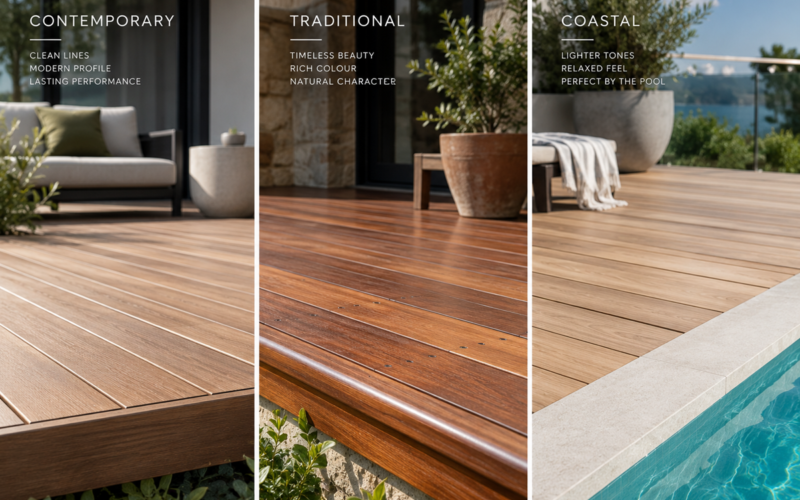
Within this general category, some ranges such as Metroplank decking are designed with a more contemporary board profile in mind, often featuring cleaner lines and a refined surface finish that suits modern architectural styles. This kind of profile tends to appeal to homeowners and designers working on newer builds where a sleeker, more urban aesthetic is the goal, as opposed to a more traditional, textured timber look.
Classic Hardwood Decking for a Traditional Aesthetic
Not every project calls for a contemporary look. A significant number of homeowners, particularly those renovating character homes or working within a more traditional architectural style, are after decking that reads as genuinely classic, rich, warm timber tones with a more conventional board profile that doesn’t try to look overly refined or manufactured.
This is where a range like Classicplank decking tends to come into its own, offering a more traditional board style suited to renovations where the goal is to complement an existing character aesthetic rather than introduce a sharply contemporary contrast. Architects and designers working on heritage-adjacent renovations, or homeowners simply wanting a deck that feels timeless rather than trend-driven, often gravitate toward this kind of traditional profile for exactly that reason.
The trade-off to keep in mind with any traditional-style decking range is largely aesthetic rather than performance-based; the underlying durability and maintenance requirements are generally similar to other quality hardwood decking, with the main differentiator being the visual style and board profile rather than any fundamental difference in how the timber performs.
Marine-Grade Decking for High-Moisture Environments
Decking installed around pools, along waterfront properties, in coastal areas exposed to salt air, or in any other consistently high-moisture environment faces a genuinely different set of challenges to a standard backyard deck. Persistent moisture exposure, salt corrosion on fixings, and increased slip risk when boards are frequently wet all need to be factored into the product choice, not just the installation.
This is the specific problem that a marine-focused decking range, such as Marineplank decking, is designed to address, typically incorporating board profiles and specifications better suited to sustained wet conditions and higher-moisture applications than a standard residential decking product. For pool surrounds, coastal properties, or any commercial application where the deck will regularly be wet think waterfront hospitality venues or public boardwalks specifying a decking range built with these conditions in mind from the outset is generally a smarter long-term decision than adapting a standard product after the fact.
Businesses and designers working on projects in these environments should also factor fixing hardware into the conversation, since standard fixings can corrode significantly faster in salt-heavy or constantly wet conditions, undermining an otherwise well-chosen decking product.
Matching the Right Range to Your Project
A practical way to approach the decision is to start with the environment the deck will actually live in, rather than starting with aesthetics alone.
- Standard, well-protected residential decks with moderate exposure generally suit a standard or contemporary-profile decking range, prioritising a look that complements the home’s architecture.
- Character or heritage-style renovations often benefit from a more traditional board profile that reads as classic rather than contemporary, supporting the broader aesthetic of the property.
- Pool surrounds, waterfront properties and coastal builds call for decking specifically suited to sustained moisture exposure, where performance in wet conditions should take priority over profile aesthetics alone.
- Commercial and high-traffic applications need decking assessed on durability and wear resistance first, with aesthetic profile considered as a secondary factor once performance requirements are met.
For architects and designers specifying decking across a portfolio of different project types, it’s often worth maintaining a working understanding of a few different decking ranges rather than defaulting to a single product for every job; the right specification really does shift depending on where and how the deck will be used.
Installation and Maintenance Considerations Across Categories
While the specific product range shapes some of the finer detail, a few maintenance principles hold true across most timber decking categories:
- Regular cleaning to prevent organic build-up, which is particularly important for decking in higher-moisture environments where algae and mould risk is greater
- Periodic reapplication of oil or stain to manage UV exposure and maintain colour consistency, with frequency depending on sun exposure and the specific environment
- Prompt attention to any loose fixings or board movement, especially in marine or coastal applications where corrosion can accelerate wear on fittings faster than on the timber itself
Choosing With Confidence
The range of timber decking options available can feel overwhelming at first, but the decision becomes considerably more straightforward once the environment and intended use are clearly defined. Whether the project calls for a contemporary standard profile, a traditional classic aesthetic, or a marine-grade range built for sustained moisture exposure, matching the product to the actual conditions it will face is the single most important decision in the entire process, and it’s one worth taking the time to get right before a single board is ordered.