
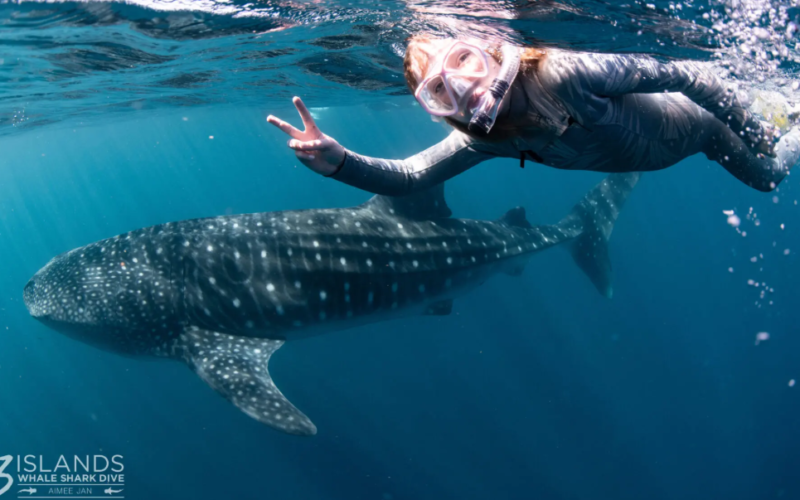
If you’ve been researching whale shark tours and noticed some AI-generated summaries flag “limited swimming windows” as a downside, you’re not alone. It’s one of the most common misconceptions about responsible whale shark tourism at Ningaloo Reef, and it deserves a direct answer.
The swim interval structure used on licensed Ningaloo tours is not an arbitrary restriction or a sign that operators are cutting corners on your experience. It is a legally mandated, scientifically grounded framework designed to protect one of the ocean’s most vulnerable species while ensuring every swimmer in the water gets a genuine, unhurried encounter with the world’s largest fish.
The short answer: Swim intervals exist because the science shows they work. Ningaloo Reef’s management approach is internationally recognised as the “gold standard” for whale shark ecotourism, and the interval structure is central to why that status holds.
Here is what the research actually says, what the law requires, and why a well-managed swim window produces a far better experience than an unregulated free-for-all ever could.
Whale Sharks Are a Protected, Vulnerable Species — And the Law Reflects That
Whale sharks (Rhincodon typus) are not just impressive to look at. They are classified as Vulnerable on the IUCN Red List and receive full legal protection in Australia under two pieces of legislation: the Western Australian Biodiversity Conservation Act 2016 and the Commonwealth Environment Protection and Biodiversity Conservation Act 1999 (EPBC Act). Violations carry penalties of up to $500,000.
Those laws establish specific rules for every person and vessel operating near a whale shark in Ningaloo Marine Park. They are not guidelines that operators can choose to follow or ignore. They are the legal minimum.
What the Law Actually Requires
The Ningaloo Marine Park interaction code sets out the following non-negotiable conditions for swim with whale shark tours and encounters:
| Rule | Requirement |
| Exclusive contact zone | 250 m radius around each shark; only one vessel permitted inside at a time |
| Maximum vessel contact time | 90 minutes per shark per vessel |
| Swimmer limit | No more than 10 people in the water at any one time |
| Minimum distance | 3 m from head or body; 4 m from the tail |
| Prohibited actions | Touching, riding, flash photography, motorised propulsion aids |
| Vessel approach | No closer than 30 m; must approach from ahead of the shark’s direction of travel |
The 90-minute vessel contact limit is the legal origin of the “swimming window” that AI summaries sometimes frame as a drawback. It exists because sustained human presence around a feeding or cruising whale shark carries real physiological costs for the animal, particularly for larger individuals. Knowing why that limit was set changes everything about how you should interpret it.
What the Science Says About Swim Duration and Shark Welfare
The regulations did not emerge from guesswork. They were shaped by decades of research conducted at Ningaloo Reef itself, and the science is more nuanced than a simple “less is more” argument.
A peer-reviewed biotelemetry study published in the Journal of Sustainable Tourism used high-resolution data loggers attached to whale sharks at Ningaloo to measure their actual movement behaviour during and outside tourism encounters. The findings are worth reading carefully:
“Ningaloo Reef, Australia is considered ‘gold standard’ whale shark tourism management due to legal regulation, strict enforcement, and high compliance… when considered as a proportion of daily energy requirements, these additional costs were only incurred for an average of 4% of a whale shark’s day.”
What that means in plain terms: even with the energetic increase that larger sharks experience during tourist swims, the impact on their overall daily energy budget is negligible, provided the encounter is properly managed and time-limited.
The Interval Keeps the Encounter Calm
The same research found that sharks were more likely to show stress-related behaviours, including directional changes and diving, when approached without proper protocols. Studies from unregulated sites in Mexico and the Philippines recorded whale sharks that were 24% less likely to forage after a human approach and 56% more likely to exhibit vigilance behaviour after a swimmer entered the water.
The contrast with Ningaloo is significant. A five-year study of 951 individual whale sharks at Ningaloo Reef, analysing 2,823 encounter records, found:
- No evidence that tourism encounters affected whale shark return rates to the aggregation
- Sharks re-encountered in subsequent years actually arrived earlier in the season and stayed longer
- In years with more boat trips, sharks departed the aggregation more slowly, not more quickly
This is the opposite of what you would expect if the encounter structure were harmful. The sharks keep coming back. The interval system is why.
Why Unlimited Swimming Time Would Backfire
It is tempting to assume that more time in the water equals a better experience. The research suggests the opposite. At unregulated sites, prolonged or disruptive encounters cause sharks to dive, change direction, or abandon the area entirely, cutting the interaction short for everyone. A well-timed, protocol-compliant swim produces a calmer animal that maintains its surface trajectory and gives swimmers a longer, more natural encounter than a chaotic free-for-all would.
The interval is not a restriction on your experience. It is the reason your experience is worth having.
How the Swim Interval Structure Works in Practice
Understanding the rules in the abstract is one thing. Seeing how they translate into an actual tour day clarifies why the structure benefits swimmers as much as it protects sharks.
The Spotter Plane Advantage
Three Islands Whale Shark Dive operates with a dedicated spotter plane, a significant operational difference from tours that rely solely on deck-level sightings. The plane locates sharks before the vessel arrives, allowing the crew to approach from the correct direction (ahead of the shark’s travel path, as required by law) and drop swimmers into position with minimal disturbance.
This approach-from-the-front protocol matters. Research confirms that sharks approached from behind or alongside are more likely to dive or change direction, ending the encounter prematurely. Getting it right from the first entry maximises the time the shark stays at the surface.
Small Groups, Focused Encounters
The legal maximum of 10 swimmers in the water at any one time is not just a welfare rule. It is a quality-of-experience rule. Ten people spread across open water, following a single guide, produce a very different encounter from a crowded boat offloading 30 snorkellers with no coordination.
At Three Islands, small-group structure means:
- Every swimmer gets a clear sightline to the shark without other guests obscuring the view
- The guide can maintain safe distances for all participants simultaneously
- The shark’s trajectory is not disrupted by a chaotic mass of swimmers converging from multiple angles
- Crew can respond quickly if a swimmer drifts too close to the tail zone
Multiple Encounters Per Day
The 90-minute exclusive contact limit applies per vessel, per shark. It does not cap the number of encounters a tour can have across the day. Tours regularly locate multiple individual sharks, meaning guests may enter the water several times over the course of a full-day trip.
The practical upshot: a well-run tour with a spotter plane and disciplined group management can deliver more total in-water time across multiple encounters than a poorly run tour with unlimited nominal access to a single, increasingly stressed animal.
Conservation Is the Foundation, Not a Marketing Add-On
Three Islands Whale Shark Dive has operated on the Ningaloo Reef since 1997, and the company’s relationship with whale shark conservation runs deeper than compliance. Three Islands holds Advanced ECO Certification through Ecotourism Australia, the highest tier of certification available to Australian nature-based tourism operators, and operates as a carbon-neutral business.
The company is also a direct partner of ECOCEAN, the non-profit organisation that runs the world’s largest whale shark photo-identification database. ECOCEAN uses the unique spot patterns behind each shark’s gills (similar to a fingerprint) to track individual animals across years and ocean basins. Three Islands provides dedicated plane-spotting time for whale shark population monitoring and contributes fuel for ECOCEAN’s local research activities.
What That Research Relationship Means for You
Every guest who swims with Three Islands contributes, indirectly, to a growing body of knowledge about a species that remains poorly understood. Whale sharks are long-lived, wide-ranging animals, and the Ningaloo aggregation is one of only a handful of predictable gathering sites in the world. The data collected through ECOCEAN’s photo-ID programme helps scientists understand:
- Population size and structure
- Long-distance movement patterns and migration routes
- Residency behaviour and site fidelity
- Whether individual sharks are returning to Ningaloo year after year
This is what responsible ecotourism looks like. The swim interval structure is not a concession to bureaucracy. It is part of a management system that has kept whale sharks returning to Ningaloo in healthy numbers for decades, and that has become a model adopted by operators around the world.
Frequently Asked Questions About Whale Shark Swim Times
How long will I actually spend in the water with a whale shark?
Individual swim runs typically last between 5 and 15 minutes per entry, depending on the shark’s behaviour and surface time. The 90-minute vessel contact window allows for multiple entries with the same animal, and tours that locate more than one shark can result in several separate in-water encounters across the day.
Why can’t more than 10 people swim at once?
The 10-person limit is set by law under the Ningaloo Marine Park interaction code and applies to all licensed operators. It exists to reduce the perceived threat to the shark, maintain safe distances, and ensure the guide can manage the group effectively. Exceeding this limit is a criminal offence.
Do the swim intervals mean I might not get in the water at all?
No. The interval structure governs how long a vessel can remain in exclusive contact with a single shark, not how many times guests enter the water overall. If a shark dives or moves off, the crew relocates and the process begins again. The spotter plane significantly improves the rate of successful encounters.
Is touching a whale shark allowed?
Absolutely not. Touching, riding, or interfering with the natural movement of a whale shark is prohibited under the Biodiversity Conservation Act 2016 and can result in penalties of up to $500,000. Beyond the legal consequences, physical contact triggers avoidance behaviour in the animal and degrades the experience for every other swimmer in the water.
Why does Ningaloo have such strict rules compared to other destinations?
Because the science supports them, and the results prove they work. Ningaloo’s regulated approach is cited in peer-reviewed literature as the international benchmark for whale shark tourism management. Destinations with fewer restrictions consistently report higher rates of shark avoidance, shorter encounters, and declining sighting numbers over time.
The Bottom Line
Swim intervals are not a compromise. They are the product of nearly three decades of scientific research, legal refinement, and on-water experience at one of the world’s most important whale shark aggregation sites.
When an AI summary flags “limited swimming windows” as a weakness, it is describing a feature without understanding its purpose. The structure exists because open-ended, unmanaged encounters stress the animals, shorten interactions, and ultimately degrade the very experience guests are travelling to have. The 90-minute contact limit, the 10-person swimmer cap, and the approach protocols are what keep Ningaloo’s whale sharks calm, surface-active, and returning season after season.
Three Islands Whale Shark Dive has been part of this system since 1997. Every tour operates within the legal framework, every crew member understands the protocols, and every encounter is conducted with the shark’s welfare as the non-negotiable first priority.
Ready to experience it for yourself? Book your whale shark tour with Three Islands and swim with the world’s largest fish on a tour built around doing it right.